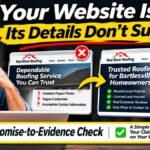

Imagine a homeowner in Bartlesville, Oklahoma, searching for a roofing company after discovering water stains on the ceiling.
They find a local contractor’s website. The homepage looks professional. There’s a beautiful photograph of a house, an attractive layout, and a large headline that reads:
“Dependable Roofing Service You Can Trust.”
Below that, the company promises quality workmanship, experienced professionals, and exceptional customer service. Everything sounds reassuring.
But as the homeowner explores the website, something begins to feel uncertain.
The project photographs look old and provide no explanation of the work completed. The About page mentions years of experience but doesn’t identify the people behind the business. The website says the company serves local homeowners, but its service area isn’t clearly listed. There’s a contact form, but little information about what happens after someone submits it.
The company may genuinely provide excellent roofing services. Nothing on the website necessarily proves otherwise. But the visitor has encountered a problem.
The website makes promises without giving people enough visible evidence to evaluate them.
That’s a credibility gap. And it’s one of the more subtle website design mistakes small business owners can overlook.
Business owners know their own experience, qualifications, and commitment to customers. Visitors don’t. They can only evaluate what the website shows them.
The difference between those two perspectives matters because a statement that feels obvious to the business owner may sound like an unsupported claim to someone encountering the company for the first time.
The Difference Between Making a Promise and Supporting It
Most small business websites contain promises. Some are direct.
“We provide dependable service.”
“We deliver professional results.”
“Customer satisfaction is our priority.”
Others are implied through words such as trusted, experienced, reliable, affordable, or high-quality.
There’s nothing inherently wrong with these statements when they’re accurate. The problem begins when a website relies on them to establish credibility without showing visitors why they should believe them.
Consider two roofing company headlines.
The first says:
“Professional Roofing Services You Can Trust.”
The second says:
“Residential Roof Repairs in Bartlesville, With Photos of Our Completed Local Projects.”
The first communicates a promise. The second communicates a service, a location, and a way for visitors to examine relevant work.
Neither headline guarantees that the company is trustworthy. But the second gives visitors something more concrete to investigate.
That reveals a useful distinction.
A promise tells customers what to believe. Evidence gives them something to evaluate.
This distinction changes how you should think about website trust signals. Instead of asking whether your website sounds professional, ask whether its important claims are supported by relevant, accurate, and accessible information.
A business can have a beautifully designed website and still leave visitors uncertain. It can also have a relatively simple website that communicates credibility through clear explanations, authentic photographs, accurate business details, and transparent processes.
Appearance helps establish an initial impression. Evidence helps visitors decide whether that impression is justified.
And not every claim requires the same kind of evidence. A statement about local service should be supported by clear location information. A statement about workmanship is better supported by relevant project examples. A claim about qualifications needs accurate, verifiable credentials. A claim about customer satisfaction is more meaningful when visitors can examine authentic customer feedback.
The evidence should match the promise.
A photograph of an attractive office doesn’t establish that a roofing contractor performs quality repairs. A five-star graphic created by the website designer doesn’t establish actual customer satisfaction. And a statement that a company is licensed doesn’t help visitors verify that claim unless the business provides appropriate, accurate details.
The goal isn’t to fill every page with badges and testimonials. It’s to connect important claims with evidence that genuinely supports them.
The Roofing Company That Looked Trustworthy Until Visitors Looked Closer
Consider a fictional roofing company called Red River Roofing. The company provides residential roofing services in Bartlesville and nearby communities. Its homepage features three prominent statements:
“Experienced Roofing Professionals.”
“Quality Workmanship.”
“Dependable Local Service.”
These statements might all be accurate. But the website provides very little supporting information.
The About page contains a short paragraph describing the company as experienced and customer-focused. The gallery shows several houses without captions. The contact page contains a form but no explanation of the company’s response process. The website’s service area is difficult to find.
Now imagine the business owner performs a credibility review. Instead of rewriting every page, they examine the evidence supporting each claim.
For the experience claim, they add accurate information about the company’s background and the types of roofing projects it handles. If the company can verify its years in business, that information can be included.
For workmanship, they replace anonymous gallery images with photographs of actual completed projects, used with appropriate permission. Each project includes a short explanation. One might describe replacing damaged shingles on a residential roof. Another might explain a flashing repair around a chimney. A third might show a roof replacement project and identify the general community where the work occurred.
These descriptions don’t need exaggerated language. They simply help visitors understand what work was performed.
For local service, the company adds a clear service-area section identifying the communities it actually serves. For customer confidence, it provides authentic reviews where permission and applicable platform rules allow. And for the contact process, it explains what customers can expect after requesting an inspection.
Notice what changed. The business didn’t become more experienced. Its workmanship didn’t automatically improve. Its service area didn’t expand.
The website simply became better at communicating what the business could already substantiate.
That’s the value of matching promises with evidence. The company isn’t asking visitors to accept every claim without question. It’s giving them relevant information they can use to make a more informed decision.
There’s also an important boundary. The company shouldn’t add a “Licensed and Insured” badge merely because competitors display one. It should make that statement only when it’s accurate and appropriate for the work and jurisdiction involved.
Likewise, it shouldn’t invent customer reviews, display fictional project photographs as real work, or claim qualifications it can’t verify.
Credibility isn’t created by adding the appearance of proof. It’s strengthened by making genuine evidence easier to find.
The Promise-to-Evidence Check
Here’s a practical method small business owners can use to evaluate website credibility. It’s called the Promise-to-Evidence Check.
The principle is straightforward. Every important promise on your website should have an appropriate form of supporting evidence. You don’t need expensive software or a complete redesign to begin.
Start with your homepage. Read the main headline, supporting text, service descriptions, and calls to action. Identify the statements that ask visitors to believe something important about your business. These might include claims about experience, reliability, service quality, local knowledge, responsiveness, or customer satisfaction.
Then ask one question:
What can a visitor actually see that supports this statement?
Don’t answer using information you know about your company but haven’t included on the website. Evaluate only the evidence a first-time visitor can access.
This is where business owners often discover the difference between what they know and what customers can verify.
You might know that you’ve completed hundreds of projects. But if your website contains no meaningful project examples, visitors can’t examine that experience. You might know that your company has served the same community for many years. But if your website doesn’t clearly identify your location or history, visitors may struggle to recognize that local connection. You might know that customers appreciate your work. But if the website contains only generic statements about satisfaction, visitors have little independent evidence to consider.
The purpose of the check isn’t to question your integrity. It’s to identify information gaps between your business’s claims and what visitors can reasonably evaluate.
How to Find the Credibility Gaps on Your Website
A simple three-part classification makes this review easier.
Supported: The website provides relevant, accurate evidence that reasonably supports the claim.
Partially Supported: Some evidence exists, but it’s vague, difficult to find, outdated, or incomplete.
Unsupported: The website makes the claim without providing meaningful supporting information.
Consider a landscaping company whose homepage says:
“We’re your trusted local landscaping experts.”
The website identifies the company’s service area and provides several photographs of completed landscaping projects. Those details support its local presence and show examples of its work. But the photographs don’t identify the services performed, and the About page provides little information about the company’s background.
The claim may be partially supported. The next step isn’t necessarily to remove the headline. It may be to improve the project descriptions and business information.
Now consider a company claiming:
“Over 20 Years of Professional Experience.”
If that claim is accurate, the website should explain what the experience refers to. Does it describe the owner’s professional background? The combined experience of employees? Or the number of years the business itself has operated?
Those are different claims. Visitors shouldn’t have to guess. This is one reason specific information often communicates more than broad marketing language. It reduces ambiguity.
The same principle applies to customer reviews. A testimonial that says “Great company!” may be genuine, but it provides limited detail about the customer’s experience. A permitted, authentic review describing the service performed, communication, and outcome gives visitors more context.
However, reviews should never be edited in ways that change their meaning or presented as verified when they aren’t.
The Promise-to-Evidence Check also applies to contact information. A website promising responsive service should make it reasonably easy for customers to initiate contact.
If the business provides a contact form, the page can explain what happens after submission. Will the customer receive a confirmation? Does the business normally respond by phone or email? Are there established business hours?
Only publish response expectations the company can reasonably meet. A vague promise of immediate assistance can create unnecessary disappointment if the business doesn’t provide that level of availability.
This leads to another useful distinction.
Evidence doesn’t always need to prove superiority. Sometimes it simply needs to remove uncertainty.
A clear service area doesn’t prove that a roofing company is better than its competitors. But it helps visitors determine whether the company is relevant to them. An accurate photograph of the business owner doesn’t guarantee excellent service. But it helps customers understand who is behind the company. A transparent explanation of the estimate process doesn’t guarantee a particular outcome. But it makes the next step more predictable.
These details matter because visitors aren’t always looking for proof that a business is the best. Often, they’re trying to determine whether the business is real, relevant, and worth contacting. When those basic questions remain unanswered, stronger marketing claims may not solve the problem.
Make Your Evidence as Visible as Your Promises
Once you’ve identified credibility gaps, resist the temptation to add every possible trust signal. More isn’t automatically better. A page filled with badges, review graphics, certifications, and promotional claims can become difficult to understand.
Instead, prioritize the evidence that supports the decisions visitors are trying to make.
For a roofing service page, project photographs and explanations of the work may be especially useful. For an About page, accurate information about the people behind the business may matter more. For a contact page, clear business information and an understandable inquiry process can reduce uncertainty.
Place evidence near the claim it supports whenever practical. If a service page promises careful roof repairs, relevant project examples belong near the service explanation rather than being buried several clicks away. If a homepage emphasizes local service, the location information should be easy to recognize. If the business highlights professional qualifications, accurate details should be accessible without forcing visitors to search extensively.
This approach makes website credibility part of the customer journey rather than a separate collection of decorative elements. It also provides a useful rule for deciding what to improve first.
Start with claims that influence whether someone contacts your business. A vague statement about company values may be less urgent than an unclear service area, missing contact details, or unsupported qualifications. Focus on the gaps that affect a visitor’s ability to understand and evaluate your business.
And remember that credibility information needs maintenance. Project galleries can become outdated. Services change. People join or leave. Business hours and contact methods may change. Credentials may need updating. A website that was accurate when published can gradually become less useful if those details aren’t reviewed.
That doesn’t mean every older project photograph must be removed. Older work can still demonstrate relevant experience when it’s accurately identified. The important question is whether the information remains truthful and useful.
Before investing in more advertising or another website redesign, perform the Promise-to-Evidence Check on your most important pages. Identify the claims that matter most. Find the evidence that supports them. Strengthen what is incomplete. Correct what is inaccurate. And remove claims you can’t substantiate.
You may discover that your website doesn’t need more promises. It needs to make the evidence behind its existing promises easier to see.
Here’s the rule: If your website asks customers to believe something important about your business, give them a truthful, relevant reason to believe it.
That’s how you begin turning professional-looking website content into information customers can actually use to make a decision.
Try This With AI: Free reader prompt
Act as an expert small business website credibility auditor, customer trust strategist, and conversion-focused website consultant. Your task is to perform a thorough Promise-to-Evidence Check that reveals where my website makes claims it doesn’t adequately support and identifies the most important credibility gaps that could cause potential customers to hesitate. Evaluate my website strictly from the perspective of a first-time visitor who knows nothing about my business. Here is my website information: [Paste your homepage headline, About section, service descriptions, trust claims, project information, customer reviews, business credentials, service area, and contact details. Example: “Red River Roofing serves homeowners in Bartlesville, Oklahoma. Homepage headline: Dependable Roofing Service You Can Trust. Claims: Experienced professionals, quality workmanship, dependable local service, and customer satisfaction. Website evidence: Three older roofing photographs without descriptions, a short About page with no company history, no visible customer reviews, an online contact form, and no clearly identified service area.”] First, identify the five most important promises or credibility claims and evaluate each using three classifications: Supported, meaning relevant evidence is visible; Partially Supported, meaning some evidence exists but is incomplete, vague, outdated, or difficult to find; and Unsupported, meaning the claim lacks meaningful visible evidence. Present the findings in a simple table showing each claim, its classification, the evidence currently available, what’s missing, and the specific uncertainty a potential customer might experience. Distinguish between a claim that lacks visible support and a claim that is actually false, since missing evidence doesn’t prove dishonesty. Next, identify the three credibility gaps most likely to influence whether a visitor contacts the business, ranking them by their relevance to the customer’s decision rather than their visual appearance. For each gap, recommend one practical improvement, explain what genuine evidence would resolve the uncertainty, and specify exactly where that evidence should appear on the website. Where appropriate, suggest clearer wording that communicates only what the supplied information can support. Pay special attention to vague experience claims, generic promises of quality, unidentified project photographs, unclear service areas, missing business information, customer reviews, and uncertain contact expectations, but only flag problems that genuinely apply to my supplied content. Don’t recommend adding decorative trust badges or unnecessary testimonials simply to make the website look more impressive. Never invent credentials, licenses, insurance, project results, business history, customer reviews, guarantees, or statistics, and clearly label any reasonable inference. Finish with a prioritized Promise-to-Evidence Action Plan containing the three most valuable changes I can make without redesigning my entire website, followed by one clear decision rule I can use to evaluate future website claims. Keep your analysis specific, practical, affordable, and easy for a small business owner to implement. Your goal isn’t to make my website sound more trustworthy through stronger marketing language. It’s to help visitors find truthful, relevant evidence that supports what my business already promises. WEBSITE REVIEW OUTPUT TEMPLATE: Organize your complete review using these six sections in this exact order: 1. Website Credibility Snapshot: Identify the business, its apparent audience, the strongest visible trust signal, and the biggest credibility concern. Give an overall assessment of Strong, Needs Improvement, or Significant Gaps, based only on the supplied information, and explain the rating in two or three sentences. 2. Promise-to-Evidence Scorecard: Create a table with five columns: Website Claim, Available Evidence, Assessment (Supported, Partially Supported, or Unsupported), Customer Concern, and Recommended Fix. Evaluate up to five important claims, prioritizing those most relevant to the customer’s decision. 3. Top Three Credibility Gaps: Rank the three most important issues and explain why each matters, what genuine evidence is needed, and exactly where it should appear. 4. Recommended Website Improvements: Provide specific, ready-to-use replacement wording where the available facts support it, plus practical recommendations for project photographs, business information, service-area clarity, reviews, and contact expectations when relevant. Clearly distinguish changes that can be made immediately from changes requiring additional verified information. 5. Priority Action Checklist: Present three concrete improvements in priority order, each with a brief explanation of what to change, where to change it, and how to confirm that the improvement is complete. 6. Final Website Credibility Verdict: Summarize the most important finding in three sentences or fewer, identify the single highest-priority action, and end with this decision rule: “If your website asks customers to believe something important about your business, give them a truthful, relevant reason to believe it.” Make the report professional, clearly organized, and suitable for a small business owner to save, print, or use as a practical website improvement checklist. If the supplied information is incomplete, identify the limitation instead of inventing missing evidence.
Want a second set of eyes on your website?
Washington IT Solutions is right here in Bartlesville, helping local small businesses — including contractors and home-service companies — get websites that are clearer, easier to contact, and easier to find. If you’d like help with yours, request a quote or give me a call.