
You did everything right. You claimed the profile, uploaded the photos, collected the reviews. You filled in every field Google asked for. And still — somehow — the business down the street, the one that opened eighteen months ago with half your credentials and a fraction of your reputation, sits in the top three results while you hover somewhere beneath the fold, invisible to the exact customers who need you most. That is not a fairness problem. It is a visibility score problem. And the gap between where you are and where you deserve to be is closer than you think.
What a Google Maps Visibility Scorecard Actually Is — and Why It’s Quietly Running Your Business
Most local business owners carry a dangerous assumption into their Google Maps strategy: that rankings work like a popularity contest. Most reviews wins. Oldest business wins. Biggest brand wins. It is a reasonable assumption. It is also wrong — and that wrongness is the reason so many genuinely great businesses stay invisible while mediocre competitors collect customers they never earned.
Google does not hand out 3-Pack placements based on seniority or star counts. It runs every single Google Business Profile through a multi-dimensional evaluation — a composite scoring process that weighs dozens of signals at once, cross-references behavioral data from millions of prior searches, and then makes a judgment call about which three businesses in your market it trusts enough to recommend to a human being who is ready to spend money right now.
That judgment call is your visibility score.
It is not a metric Google shows you. There is no dashboard, no percentage, no progress bar. It exists as a silent verdict — Google’s confidence level in your business as a result worth serving. When that confidence is low, your profile gets filtered out before the competition even begins. When it is high — when your signals align, your trust indicators fire, your behavioral data confirms you are active and relevant and exactly what you claim to be — Google puts you at the top and the phone starts ringing without a single paid ad.
Here is what makes this so worth understanding. Google’s entire business model runs on one promise: search here, trust the results, find what you need. Every time Google breaks that promise — every time a searcher clicks on a business that is closed or irrelevant or unresponsive — it erodes the user trust that makes Google worth using. Google cannot afford to guess. Your visibility score is the mechanism it uses to only bet on certainties.
Which means the question is not whether Google is evaluating you. It is whether you are giving it enough reasons to choose you.
THIS IMAGE IS FOR ILLUSTRATION ONLY
Why 2026 Changed Everything About Local Search
The ground shifted. Not gradually — seismically, in the span of about eighteen months, three forces collided and permanently rewrote the rules of what it takes to rank in the Google Maps 3-Pack.
The first force was AI. Google’s evolving AI overview system now surfaces local business recommendations inside generated summaries that appear before traditional map results even load. If your entity presence is weak — if your profile signals are thin, inconsistent, or semantically poor — the AI layer simply does not consider you. You are not ranked lower. You are not in the conversation at all.
The second force was behavioral intelligence. Google has always tracked what users do after seeing a result. But its ability to interpret those behaviors — to distinguish between a click that converted and a click that bounced, between a direction request from a genuinely interested customer and an accidental tap — has become extraordinarily refined. In 2026, what people do with your listing matters as much as how well you filled it out. An optimized profile that nobody engages with will eventually lose to a less polished profile that generates consistent, real interaction.
The third force was competitive saturation. A few years ago, claiming your GBP and adding a handful of photos was enough to outrank half your market. That era ended. Almost every local market now has at least a cluster of businesses that have had some level of professional optimization. The floor rose. What used to be advanced strategy is now the baseline — which means the 12 signals in this scorecard are not a secret weapon anymore. They are the price of admission.
Understand that context, and the work ahead takes on the right weight. You are not updating a directory listing. You are building a living entity inside Google’s Knowledge Graph — something that needs to continuously earn its position by proving relevance, authority, and trust to an algorithm that never stops paying attention.
How to Use The Google Maps Visibility Scorecard Without Drowning in It
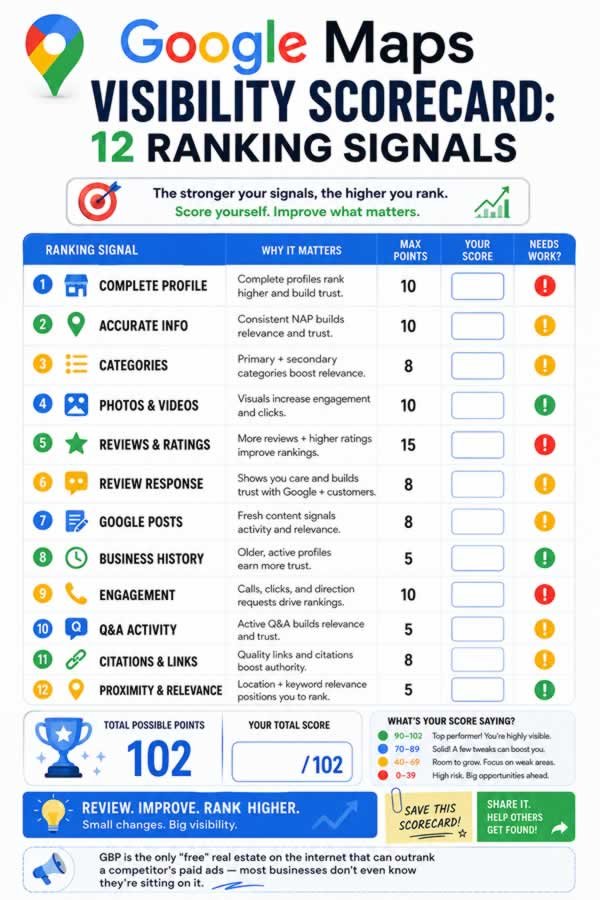
Twelve signals sounds like a lot. It is not, once you understand how they relate to each other. Some signals determine whether Google considers you a candidate for local results at all. Others are what push you into the top three instead of the top ten. A final group determines whether you hold that position under competitive pressure or slowly lose it.
Work through these sequentially on your first pass. The signals build on each other — optimizing them in isolation produces modest lifts, but implementing them as an integrated system produces the kind of ranking shift that makes your competitors wonder what happened. The businesses that treat this as a checklist get incremental results. The ones that treat it as an architecture get compounding ones.
Signal 1: Primary and Secondary Category Precision
Your primary Google Business Profile category is the single most powerful declaration you make to Google about what your business actually is. It is the first relevance filter the algorithm applies — before it reads your description, before it counts your reviews, before it evaluates anything else. If your category does not match the search intent at the entity level, you are disqualified before the competition starts.
The mistake almost everyone makes is choosing a category that describes their industry rather than their specific service. A plumber who selects “Plumber” as a primary category when “Emergency Plumber” is available is swimming in the deepest, most competitive pool when a shallower one with far less competition is right there. A dentist who picks “Dentist” instead of “Cosmetic Dentist” has chosen volume over relevance — and paid for it in rankings they will never see.
Secondary categories are where the real opportunity lives, and almost nobody is taking it. Google allows up to ten. Each additional relevant category expands your profile’s semantic footprint — the range of queries for which you are even considered a result. A residential cleaning company that adds secondary categories for carpet cleaning, window cleaning, and commercial cleaning has tripled its query coverage in thirty seconds. Most businesses stop at two.
Pull a current list of every available GBP category in your vertical. Cross-reference against the actual language your customers use when they search. Your primary category should match your highest-value service, not your broadest one. Fill every secondary slot with something legitimate. This is foundational work — and skipping it makes every other signal you optimize worth less than it should be.
Signal 2: Business Description NLP Alignment
Your 750-character business description is not a marketing bio. Stop writing it like one.
To Google’s natural language processing systems, that description is an instruction set. It tells Google which entities, services, and locations your business should be associated with. A description full of personality and warmth but empty of specific, rankable information gives Google almost nothing to work with. And Google, presented with nothing useful, has no choice but to rank you behind competitors who gave it something.
The contrast is stark. Consider two plumbers:
The first: “Smith’s Plumbing has been proudly serving our community for over fifteen years. We offer a full range of plumbing services at honest prices and stand behind every job we do. Give us a call — we would love to earn your business.”
The second: “Smith’s Plumbing handles emergency plumbing repair, water heater installation, and drain cleaning across Dallas and surrounding areas. Our licensed master plumbers offer same-day service for residential and commercial properties throughout Collin, Dallas, and Denton counties. With over 4,000 completed jobs since 2009, we specialize in trenchless pipe repair and leak detection.”
The first description has warmth. The second has rankable intelligence. It contains service entities (“emergency plumbing repair,” “water heater installation”), geographic entities (“Collin County,” “Denton County”), and credibility signals (“licensed master plumbers,” “4,000 completed jobs”). Google’s BERT model reads that second description and builds a rich, confident association map. The first one? It builds goodwill that no algorithm can use.
Rewrite yours from scratch. Use every character. Let Google’s own autocomplete and related searches guide your entity language. Every word in that description should be earning its place.
Signal 3: Google Posts Frequency and Engagement Rate
A dormant Google Posts feed tells the algorithm something specific: this business is either declining, inactive, or not paying attention. In a system designed to surface the most reliable, active local businesses, silence reads as a red flag.
Posts work on two levels simultaneously. On the surface, they are a freshness signal — proof that a real business is operating and paying attention. Below the surface, each Post is indexed content associated with your GBP entity. Posts that include your target service terms and location language create additional NLP confirmation layers, essentially re-certifying your relevance to Google with every publication. Posts that generate user interaction — clicks, call-to-action taps — produce behavioral signals that compound into your overall profile score.
Weekly is the minimum cadence for competitive markets. Businesses in heavily contested niches that post three to four times per week consistently outperform less active competitors with otherwise superior profiles. The content matters less than the consistency, though Posts that spark real interaction carry disproportionate weight.
Four Post types work best in rotation: Offers and promotions (highest click rates), Event Posts (longest engagement time), Product Posts (broadest keyword entity expansion), and Update Posts (strongest freshness signal). Cycle through all four. The behavioral signal profile that rotation creates signals a multi-dimensional, actively engaged business — exactly the kind Google is comfortable recommending.
Signal 4: Photo Upload Consistency and Subject Diversity
Google’s image recognition systems are not passive. Every photo you upload is analyzed for content, assessed for quality, matched against your declared business category, and timestamped for recency. The upload metadata tells Google a story about your business’s activity level. Whether that story is reassuring or concerning depends entirely on what you have uploaded and when.
A profile with forty photos uploaded three years ago and nothing since reads algorithmically as a business in decline. A profile with fifteen photos uploaded steadily over the past six months — fewer in total, but fresher — outperforms it on the recency dimension every time.
Subject diversity matters equally. Google rewards profiles that show multiple facets of a business: interior and exterior shots, team photos, work-in-progress images, before-and-after documentation, specific equipment, branded vehicles, completed projects. A profile that only shows team headshots has a thin image entity profile. One that cycles through every relevant subject category builds rich visual associations that reinforce your keyword relevance from a direction most competitors never think about.
One tactic almost nobody is using: geo-tagging photos before upload. Embedding your GPS coordinates in image metadata using a tool like GeoImgr adds a geographic entity signal at the file level — a layer Google’s systems absolutely read, and one that quietly reinforces your local relevance every time you upload something new. Four to eight photos per month, consistently geo-tagged, across rotating subject categories — that habit, maintained over a year, creates an advantage that is structurally difficult to overcome.
Signal 5: Review Quantity, Recency, and Owner Response Rate
Reviews are the most visible element of your profile and the most behaviorally complex. They influence how humans decide whether to trust you and how algorithms decide whether to rank you — simultaneously, through different mechanisms, at the same time.
But the review metrics that matter most in 2026 have shifted. Most businesses have not recalibrated.
Recency now outweighs quantity. A profile with 200 reviews and none in the past ninety days is algorithmically weaker than a competitor with 60 reviews and a fresh one arriving every week. Google interprets review velocity as a business activity signal. Recent reviews mean recent customers. Recent customers mean an operating business worth recommending.
Review content is a keyword signal most people miss entirely. Google reads every review and extracts entities. A review that says “Mike fixed our pipe burst at 11pm — professional, fast, explained everything” contains rankable content: “emergency,” “pipe,” “professional.” A review that says “Great service!” contains none. Businesses that coach customers toward specific, detailed reviews — within Google’s guidelines — build a review entity corpus that reinforces keyword relevance far beyond what star ratings accomplish alone.
Owner response rate is an E-E-A-T signal that is hiding in plain sight. Google treats active owner engagement as a trust indicator. A business owner who responds thoughtfully to reviews — positive and negative — demonstrates the kind of customer-focused operation Google wants to recommend. Profiles with sub-50% response rates are quietly losing authority on a dimension they may not even know Google is measuring.
Build a systematic approach to review acquisition: post-service follow-up sequences, QR codes linking directly to your review page, and verbal requests made at the exact moment of highest customer satisfaction. Two to three new reviews per week, sustained, will outpace 90% of local competitors within six months.
Signal 6: Q&A Section Population and Keyword Density
The Questions and Answers section of your GBP is the most algorithmically neglected feature in local SEO. It is also, in the wrong hands, one of the most dangerous — and in the right ones, one of the most powerful.
The danger first: anyone can post a question on your profile, and anyone can answer it. Competitors can. Confused customers can. Bots sometimes do. Businesses that have never reviewed their Q&A sections often have misleading or outright incorrect answers sitting publicly, influencing potential customers and quietly confusing Google’s understanding of what they offer.
The opportunity: every question and answer pair is indexed content associated with your GBP entity. A Q&A section populated with twenty thoughtfully crafted questions — and keyword-rich, authoritative answers — extends your profile’s topical coverage in ways the description field and posts cannot fully achieve.
You can seed your own Q&A. Ask questions from a personal Google account (not your business account) and answer them as the business owner. Structure each question the way a real customer would phrase a search query. Structure each answer to satisfy both the human reader and Google’s NLP extraction. This is not gaming the system — it is serving the system the information it needs to serve your customers correctly.
Signal 7: Website Linkback Authority to Your GBP Entity — The One Your Competitors Haven’t Touched
Here it is. The signal that explains everything. The reason some businesses seem to jump from nowhere into the 3-Pack with what looks like inexplicable speed. The reason others — with better reviews, more complete profiles, more consistent posts — can’t seem to crack the top three no matter what they do.
Most business owners treat their website and their Google Business Profile as separate things. A website over here. A GBP listing over there. Two assets, two strategies, two separate concerns.
Google does not think this way. To Google’s Knowledge Graph, your business is a single entity — and your website, your GBP, your social profiles, your citations, your review platform pages are all just different data points that Google triangulates to build its confidence model for that entity. When those data points align perfectly, confidence is high. When they contradict each other — subtly, even — confidence drops, and your visibility score pays the price.
This is entity reconciliation. Google matches the business name, address, and phone number on your website against your GBP data against your directory listings against your review profiles. Every consistent match is a confidence vote. Every inconsistency — an old address on a forgotten directory, a slightly different business name format, an outdated phone number — is a doubt signal. Small ones accumulate into a meaningful drag. Most businesses have dozens of them and have no idea.
But this signal runs deeper than NAP consistency. The external links pointing to your website carry authority that transfers to your GBP entity evaluation. A business whose website receives links from local news outlets, community organizations, the chamber of commerce, industry associations, and neighborhood blogs carries a dramatically higher entity authority score than an otherwise identical business with no external web presence. This is traditional SEO wisdom — domain authority matters — applied to the local search context. And it remains one of the least-implemented tactics in the local business owner’s toolkit, because Google’s own documentation never quite explains how it works.
The full implementation:
Start with a character-by-character NAP audit. Your website footer, your contact page, your GBP, every directory listing — they must all say exactly the same thing. Not approximately. Exactly. Then add Local Business schema markup to your website’s homepage and contact page. Add Service schema to every individual service page. Embed your Google Maps widget on your contact page using a direct link to your GBP listing. Build a local link acquisition strategy that targets community sites, local press, and industry associations in your geographic market. Run a full citation audit using Bright Local or Whitespark, and correct every inconsistency you find.
The businesses that implement Signal 7 completely — and then maintain the discipline of entity consistency over time — build a ranking foundation that competitors struggle to dismantle, no matter how aggressively they chase reviews or posts. Because those competitors are building on sand. Entity authority is bedrock.
Signal 8: Service Menu Completeness and Keyword Mapping
The Services section exists to let you describe your offerings with precision. Most businesses either ignore it entirely or fill it out once, generically, and forget it exists. Both approaches leave meaningful ranking ground uncovered.
Think of the Services section as an extended entity declaration. Each service you list — with its name, description, and price point — is indexed content that expands the range of queries for which your profile qualifies as a relevant result. A home services company that lists fifteen specific services with detailed, keyword-rich descriptions occupies a dramatically broader semantic footprint than a competitor with three generic categories.
The description field allows up to 300 characters per service. Use them. Every description should include the service name, a specific detail about how you perform it, a geographic modifier, and a differentiating element. “Residential roof replacement using GAF and Owens Corning shingles across [City] and surrounding counties, with free inspection and transferable warranty” does more algorithmic work in one sentence than a dozen generic bullet points.
Signal 9: Citation Consistency Across 50+ Directories
A citation is any online mention of your business name, address, and phone number. The volume and consistency of your citation profile tells Google whether your business is real, stable, and exactly what it claims to be. It is a verification layer — and it only works when the data is consistent.
The keyword there is consistent. “Smith’s Plumbing LLC” and “Smiths Plumbing” are not the same entity to a machine reading them at scale. At the level of one inconsistency, the impact is negligible. Across forty directories with twenty small variations, the cumulative entity ambiguity becomes a genuine drag on your visibility score.
The baseline for competitive local markets is fifty high-authority directories maintained with perfectly consistent NAP data. That means the major data aggregators — Data Axle, Neustar Localeze, Foursquare — whose data feeds populate hundreds of smaller directories automatically. It means the major consumer-facing platforms: Yelp, Facebook, Apple Maps, Bing Places. And it means the vertical-specific directories that matter in your industry: Houzz for contractors, Healthgrades for medical providers, Avvo for legal professionals.
This is maintenance work, not glamorous strategy. But the businesses that let their citation profiles drift into inconsistency pay a ranking tax they cannot see — and cannot reverse without finding and fixing every instance.
Signal 10: Local Backlink Profile and Community Entity Association
Google does not evaluate your business in a vacuum. It evaluates your business within the context of your community’s digital ecosystem. A business embedded in that ecosystem — mentioned in local news, linked from neighborhood associations, listed on the chamber of commerce member directory, referenced by local bloggers and event pages — carries signals that no amount of profile optimization can manufacture from the inside.
Community entity association is one of the strongest available signals of genuine local presence. It is also extraordinarily difficult for a new competitor or a non-local business trying to rank in your market to replicate quickly. You build it over time, by actually being a part of your community — and by making sure that participation is digitally documented.
Sponsor local events and ensure your sponsorship generates a link from the event website. Join the chamber of commerce and claim your member directory listing. Offer expert commentary to local journalists covering your industry. Partner with complementary local businesses for cross-promotional content that each party publishes. Every one of these actions creates a new citation node in your local knowledge graph. Collectively, they build the kind of community presence moat that compounds for years — and that a competitor who just started optimizing their GBP cannot bridge overnight.
Signal 11: Behavioral Signals — Clicks, Calls, and Direction Requests
At some point in the evaluation of your Google Business Profile, the algorithm stops reading what you wrote and starts watching what people do. Every interaction a searcher has with your listing — whether they tap to call, click for directions, visit your website, view a photo, read a review, or engage with a Post — is a data point Google uses to decide whether your profile is genuinely compelling or just technically complete.
This distinction matters enormously. A perfectly filled-out profile that nobody interacts with will, over time, lose to a less polished profile that generates consistent, high-quality human behavior. The optimization that matters for Signal 11 is not filling in fields. It is building a profile compelling enough to generate industry-leading engagement — which means your photos need to be the kind people actually stop to look at, your reviews need to be the kind people read before deciding, and your description needs to be the kind that answers the question before the phone call.
The behavioral signals Google tracks from your profile include click-through rate from search results, website visit rate, call rate, direction request rate, photo view rate and duration, Post engagement, Q&A interaction, and messaging conversion. None of these are directly controllable. All of them are indirectly improvable — through the same quality of presence that earns real trust from real people.
Signal 12: GBP Messaging Activity and Response Latency
People do not want to call anymore. They want to text, message, ask a quick question, and get a fast answer from a real person — and then decide whether to book. Google introduced native GBP messaging because it recognized that shift, and it rewards businesses that meet customers where they are.
The mechanism is direct. Google tracks how quickly you respond to messages. Profiles that respond within minutes earn a visible badge — “Typically responds within minutes” — that meaningfully increases contact rates. Below the visible surface, response latency functions as a business activity signal. A business that responds to messages quickly is an active, customer-focused operation. Google reads that. It factors it in.
Enable messaging if you have not. Set automated welcome responses for after-hours. During business hours, fifteen-minute response times are achievable with a mobile notification setup and a small commitment of daily attention. The return — the engagement badge, the behavioral signal, the direct conversion from message to appointment — makes this the most efficient fifteen minutes of daily customer acquisition in local search.
Your 90-Day Roadmap to 3-Pack Entry
Days 1 through 30 — Build the Foundation
Signals 1, 2, 8, and 9. Category precision, description alignment, service menu completeness, citation consistency. These are structural signals that determine your baseline eligibility to rank. Everything else you build on top of them. Get them right before moving forward.
Days 31 through 60 — Build the Authority
Signals 7, 10, and 3. Website entity architecture, community link building, and Google Posts cadence. Signal 7 in particular requires sustained effort over multiple weeks — NAP audits, schema implementation, citation corrections, local link outreach. This phase is the most demanding and the most consequential.
Days 61 through 90 — Build the Engagement
Signals 5, 6, 4, 11, and 12. Reviews, Q&A, photos, behavioral optimization, and messaging. This phase activates the trust and engagement dimensions that transform a strong authority profile into a dominant, defensible 3-Pack position — and keep it there.
Why the 3-Pack Leaders Become Harder to Displace Over Time
The compound effect is the most important concept in this entire scorecard, and the most counterintuitive one.
Optimizing your primary category produces a small ranking lift. Optimizing your category and your description together produces a larger one — because the signals reinforce each other. Building reviews, posts, citations, and entity architecture on top of that foundation produces a lift that is exponentially greater than the sum of the parts. Google’s confidence model is multiplicative. Signals do not add — they compound.
This is why once a business gets into the 3-Pack and maintains its signals properly, displacement becomes progressively harder. They are not just ahead on individual metrics — they have built an interlocking authority architecture where every signal validates every other signal. A new competitor entering the market has to close the gap at every layer simultaneously.
That architecture is what you are building with this scorecard. One signal at a time, in sequence, until the whole system clicks into place and starts working for you the way it works for the leaders you are chasing right now.
Frequently Asked Questions (FAQs)
Products, Tools & Resources
Getting these twelve signals right is far easier with the right tools doing the heavy lifting. Here is what the most effective local SEO practitioners are actually using:
BrightLocal is the closest thing to a complete local SEO platform. Citation tracking, NAP auditing, rank monitoring across map results, and GBP audit tools — all in one place. If you are only going to invest in one paid platform for this work, start here.
Whitespark specializes in citation building and local link prospecting. Their citation finder is particularly useful for identifying directories your competitors are listed on that you are not, and their local rank tracker is one of the most accurate available for Maps-specific ranking data.
PlePer GBP Category Tool is a free resource that maintains a current, comprehensive list of every available Google Business Profile category. Essential for Signal 1 research — bookmark it and return whenever you expand your service offerings.
GeoImgr handles GPS coordinate embedding for photo uploads. Free, browser-based, and straightforward. Use it every time you prepare photos for GBP upload to layer in the geographic entity signal most competitors have never considered.
Semrush Local provides a solid combination of citation management, GBP optimization insights, and competitor benchmarking. Particularly useful for the entity gap analysis work involved in Signal 7.
Google Search Console is non-negotiable for monitoring how Google understands your website’s entity signals. The performance data, combined with structured data validation tools, tells you whether your schema implementation is being read correctly — and flags errors before they become ranking liabilities.
Schema.org’s LocalBusiness Markup documentation is the authoritative reference for implementing the structured data elements tied to Signal 7. Bookmark it. Return to it when implementing schema on new service pages.
Yext offers an automated citation management platform that distributes and updates your NAP data across a large publisher network simultaneously. Best suited for businesses managing multiple locations or dealing with widespread citation inconsistencies that would take months to fix manually.
Moz Local provides citation distribution and monitoring with a clean, accessible interface well-suited for business owners who want to manage their own citation profile without deep technical expertise.
Google Business Profile Help Community is underrated as a resource. Real GBP product experts and experienced practitioners answer questions, flag policy updates, and document algorithm behavior changes faster than most SEO blogs. Follow it actively and you will know about significant GBP changes before most of your competitors do.